
In today's fast-paced digital landscape, the way we build and launch products has undergone a significant transformation. At the forefront of this change is Agile - a methodology that has revolutionized how teams approach digital product development. But what exactly is Agile, and why has it become the go-to approach for so many successful tech companies?
Key Takeaways:
Agile is an iterative approach to software development that emphasizes flexibility, collaboration, and rapid delivery.
It breaks down projects into smaller, manageable chunks called "sprints."
Agile methodologies prioritize customer feedback and continuous improvement.
Popular Agile frameworks include Scrum, Kanban, and Extreme Programming (XP).
Adopting Agile can lead to faster time-to-market, higher quality products, and improved team morale.
Let's dive deeper into the world of Agile and explore how it's reshaping digital product development.
What is Agile?
At its core, Agile is a set of values and principles for software development. It emerged as a response to the limitations of traditional "waterfall" development methods, which often resulted in lengthy development cycles and products that didn't meet user needs.
The Agile Manifesto, created in 2001, outlines four key values:
Individuals and interactions over processes and tools
Working software over comprehensive documentation
Customer collaboration over contract negotiation
Responding to change over following a plan
These values emphasize flexibility, collaboration, and a focus on delivering functional software quickly and iteratively.
Why Agile for Digital Product Development?
You might wonder, "Why has Agile become so popular in the digital product world?" The answer lies in its ability to address the unique challenges of software development:
Rapidly changing technology and market conditions
Evolving user needs and expectations
The need for quick feedback and iteration
Agile methodologies are designed to thrive in this environment of constant change and uncertainty.
Key Components of Agile Development
To understand how Agile works in practice, let's break down some of its key components:
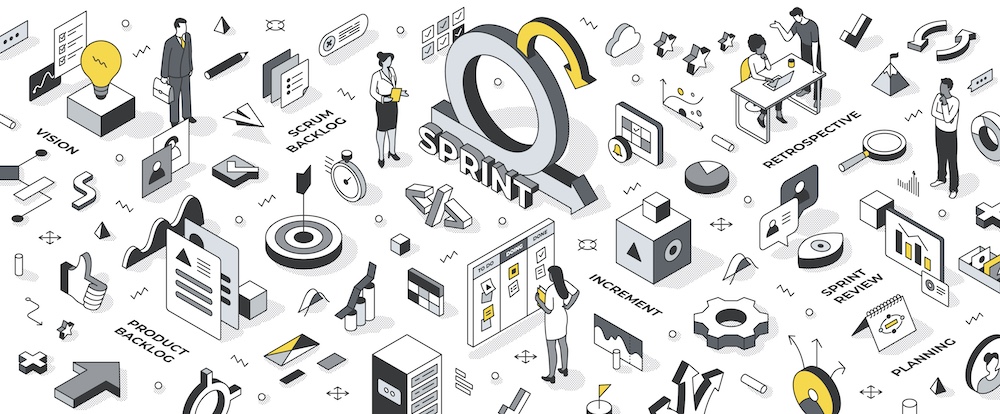
Sprints: Short, time-boxed periods (usually 1-4 weeks) where a specific set of work is completed and made ready for review.
User Stories: Brief, simple descriptions of a feature told from the perspective of the user.
Daily Stand-ups: Short, daily team meetings to discuss progress and obstacles.
Sprint Planning and Review: Meetings at the beginning and end of each sprint to plan work and review completed items.
Retrospectives: Regular team reflections on what's working well and what could be improved.
Popular Agile Frameworks
While Agile is an overarching philosophy, there are several specific frameworks teams can use to implement Agile principles:
Scrum: Perhaps the most widely used Agile framework, Scrum emphasizes self-organizing, cross-functional teams working in sprints.
Kanban: Focuses on visualizing work, limiting work in progress, and maximizing efficiency (or flow).
Extreme Programming (XP): Emphasizes technical excellence and customer satisfaction through practices like pair programming and test-driven development.
Benefits of Agile in Digital Product Development
Adopting Agile can bring numerous benefits to digital product teams:
Faster Time-to-Market: By delivering working software in short sprints, products can be launched and iterated upon more quickly.
Improved Quality: Regular testing and review cycles help catch and fix issues early.
Enhanced Customer Satisfaction: Frequent customer feedback ensures the product meets user needs.
Increased Team Morale: Agile practices often lead to more engaged, empowered teams.
Better Risk Management: Early and frequent delivery reduces the risk of project failure.
Implementing Agile: Practical Tips
Thinking about adopting Agile for your digital product development? Here are some practical tips to get started:
Start Small: Begin with a pilot project or team before rolling out Agile across the entire organization.
Invest in Training: Ensure your team understands Agile principles and practices.
Embrace Tools: Utilize project management tools designed for Agile workflows.
Foster a Culture of Collaboration: Encourage open communication and cross-functional teamwork.
Be Patient: Remember that becoming truly Agile is a journey, not a destination.
Challenges and Considerations
While Agile offers many benefits, it's not without its challenges. Some common hurdles include:
Resistance to change from team members or stakeholders
Difficulty in estimating and planning for longer-term projects
Potential for scope creep if not managed properly
Challenges in scaling Agile practices for larger organizations
Being aware of these potential pitfalls can help teams navigate them more effectively.
The Future of Agile in Digital Product Development
As we look to the future, Agile continues to evolve. Some trends to watch include:
Increased focus on DevOps and continuous delivery
Integration of AI and machine learning into Agile processes
Adaptation of Agile principles beyond software development
The key to success will be maintaining the core Agile values while adapting to new technologies and methodologies.
Agile has fundamentally changed the landscape of digital product development, offering a flexible, collaborative approach that aligns well with the fast-paced nature of technology. By embracing Agile principles and practices, teams can deliver higher quality products faster, while staying responsive to user needs and market changes.
As you consider implementing or improving Agile practices in your organization, remember that the journey to becoming Agile is itself an iterative process. Start small, be willing to adapt, and always keep the focus on delivering value to your users.
FAQ
Q: Is Agile suitable for all types of digital products?
A: While Agile can be adapted to many types of projects, it's particularly well-suited for products where requirements are likely to change, user feedback is crucial, and rapid iteration is valuable. However, some projects with very stable, well-defined requirements might benefit from more traditional approaches.
Q: How long does it take to become "Agile"?
A: Becoming truly Agile is an ongoing process rather than a destination. While basic Agile practices can be implemented relatively quickly (within a few months), cultivating an Agile mindset and fully optimizing processes often takes a year or more. The key is to start small and continuously improve.
Q: Can Agile work in remote or distributed teams?
A: Yes, Agile can absolutely work in remote or distributed settings. Many digital tools facilitate Agile practices for remote teams, such as virtual Kanban boards and video conferencing for daily stand-ups. The key is to maintain clear communication and adapt practices as needed to suit the remote environment.