

Managing cold chain logistics for enterprise pharma and FMCG brands requires unyielding precision. Cooling system failures during transit often lead to hundreds of thousands of dollars in lost cargo. This article explores how a custom software approach powered by Internet of Things (IoT) technology transforms fleet visibility and ensures full regulatory compliance.
Executive Summary & Key Takeaways
The table below outlines the operational performance metrics achieved after integrating a custom IoT telemetry software layer into a cold chain distribution network.
Operational Performance Metric | Before Software Integration | After Sprout Platform Integration |
Cargo Spoilage (Product Loss) | High (5% - 8% of total trips) | Reduced by 42% (Early anomaly alerts) |
Pharma GDP Audit Compliance | Manual & Prone to Tampering | 100% Audit-Ready (Encrypted digital logs) |
Reefer Fleet Fuel Consumption | Inefficient due to engine idling | 8% Fuel Savings (Optimized routing & cooling) |
Anomaly Response Time | > 2 Hours (Noticed upon arrival) | < 3 Seconds (Push & WhatsApp alerts) |
Industry Context & Cold Chain Challenges in Southeast Asia
As a tropical archipelago, Indonesia presents unique logistics challenges. Sensitive items like pharmaceuticals, vaccines, frozen meat, and dairy products demand strict temperature controls across land and sea transit.
Varying geographical terrain and road infrastructure exacerbate the risk of cooling failures—especially when fleets cross inter-provincial borders or endure severe traffic delays. Without automated monitoring, supply chain managers are forced to rely on manual assumptions that put product safety at risk.
Key Operational Challenges for Enterprise Fleets
Before adopting modern telemetry platforms, enterprise logistics providers were constrained by three primary operational blind spots that eroded profit margins.
Lack of Real-Time Visibility: Control tower teams at headquarters lacked live access to temperature metrics while fleets were active in the field.
Disconnected Coverage in Remote Blind Spots: Inter-city routes passing through areas without cellular coverage resulted in lost telemetry data.
Audit Rejections & Compliance Failures: Manual temperature logs filled out by drivers were frequently rejected by Good Distribution Practice (GDP) auditors due to potential tampering.
Sprout’s Telemetry Software Architecture
Sprout is a custom software house; we do not manufacture hardware sensors or reefer trucks. Instead, we build the underlying software layer connecting IoT sensors inside refrigerated compartments directly to enterprise management dashboards.
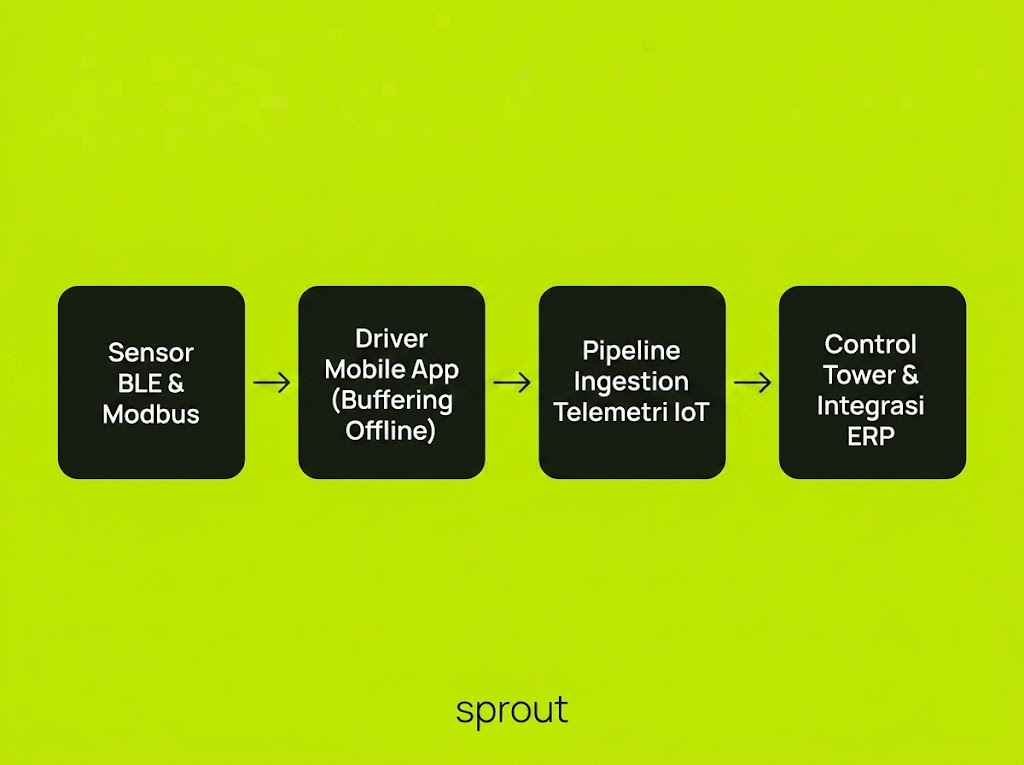
The software architecture engineered by Sprout focuses on four core modules to guarantee seamless data transmission and instant operational visibility.
1. IoT Ingestion Pipeline (Hardware-Agnostic)
Custom middleware built by Sprout ingests telemetry data from various IoT sensor brands, GPS gateways, and door sensors without hardware vendor lock-in.
2. Driver Mobile App (Offline-First Architecture)
Built with an offline-first design pattern. When a truck enters a cellular dead zone, temperature metrics buffer locally on the driver’s mobile device and automatically sync to the central server once connectivity is restored.
3. Real-Time Central Control Tower Dashboard
A web-based monitoring interface displaying live fleet locations alongside real-time temperature indicators. If ambient levels drift outside safe limits (e.g., $2^\circ\text{C} - 8^\circ\text{C}$), the system immediately dispatches automated alerts.
4. ERP Integration & Digital Certification
Connects directly to enterprise ERP environments (such as SAP, Oracle, or Odoo) to automatically issue a Digital Certificate of Temperature Compliance upon shipment arrival.
Operational Results & Business Impact
Deploying this real-time temperature monitoring software delivers quantifiable financial and operational advantages for enterprise supply chains.
42% Reduction in Cargo Loss: Early warning indicators allow drivers and control room operators to take corrective action before cargo spoils.
Paperless GDP Audit Compliance: Complete temperature histories are securely stored in the cloud, instantly exportable for regulatory verifications.
Lower OpEx & Reduced Claims: Transparent temperature tracking at the point of delivery eliminates customer disputes, lowers product returns, and accelerates insurance processing.
Ready to eliminate cold chain cargo loss and gain complete real-time visibility over your fleet operations? Sprout’s software engineering team is prepared to design and build a custom IoT telemetry architecture tailored specifically to your enterprise infrastructure, ranging from offline-first driver mobile apps to central control towers and seamless ERP API integrations.
Contact Sprout’s technology experts today to schedule a strategic consultation and discover how a custom software solution can safeguard your cold chain logistics.
Frequently Asked Questions (FAQ)
Implementing custom IoT telemetry software often raises technical questions regarding deployment timelines, hardware compatibility, and data persistence.
Does Sprout supply IoT hardware sensors or reefer trucks?
No. Sprout is a custom software house. We design and build the entire software infrastructure (ingestion pipelines, driver mobile apps, control tower dashboards, and ERP integrations) that connects to your existing IoT hardware sensors.
How does the system handle areas with no internet connection?
The Sprout driver mobile app features offline buffering. Sensor data records locally on the device every second and automatically syncs to the cloud server as soon as the vehicle re-enters network coverage.
What is the estimated timeline to integrate Sprout’s platform with our ERP?
Integration timelines depend on the complexity of your ERP’s API architecture (such as SAP, Oracle, or Odoo). Typically, Sprout’s integration module can be connected and fully operational within 4 to 8 weeks of development.