
Many large enterprises have allocated significant budgets toward artificial intelligence (AI), yet most initiatives stall at the pilot program stage or remain stuck in experimentation. However, building AI models alone is not enough; companies need a structured framework to transition technology from experimental sandboxes into reliable operational systems.
By understanding how to adopt AI in enterprise applications correctly, IT teams and business leaders can integrate AI into legacy systems without worrying about project failure midway through execution. This guide provides a practical roadmap for technology leaders to ensure every AI investment delivers measurable business impact and ROI.
What Is an Enterprise AI Adoption Guide?
An enterprise AI adoption guide (AI adoption checklist) is a strategic and technical framework designed to help companies evaluate, prepare, and execute AI integration into business application systems securely, compliantly, and in a scalable manner.
This framework covers the entire modernization lifecycle, ranging from business objective alignment, data readiness audits, and MLOps infrastructure setup, to data ethics governance and human-in-the-loop scenario implementations.
How to adopt AI in enterprise applications is a structured software engineering approach to transforming legacy applications with artificial intelligence capabilities. This approach ensures data readiness, infrastructure security, and ROI certainty before running systems at full production scale.
Why Does Your Company Need an AI Adoption Strategy?
Integrating AI without legacy system readiness and mature governance risks triggering budget overruns, data leakage, and launch failures. Implementing a structured AI adoption guide delivers distinct strategic advantages:
Preventing Stalled Projects (Anti-Pilot Traps): Ensuring projects do not stall at the Proof of Concept (PoC) stage by defining production-ready criteria from the start.
Maintaining Data Security & Regulatory Compliance: Guaranteeing that sensitive company data complies with privacy standards, such as GDPR or local data protection laws, without leaving security loopholes.
Ensuring Scalability & MLOps Performance: Seamlessly integrating AI models with microservices architectures, APIs, and event-driven systems without overburdening core application performance.
Providing Clear ROI Measurement: Directly connecting technical model performance metrics to operational efficiency and revenue growth.
Regional Case Study: How Bank Mandiri Automated Credit Verification with AI
Successful AI adoption at the enterprise level is far from theoretical. In Southeast Asia, Bank Mandiri demonstrated how this technology can transform massive administrative operations into a far more efficient workflow.
The Challenge: Every day, staff had to review and extract data from thousands of physical and digital documents for customer loan applications. This manual data entry process took days and was highly prone to human error.
The Solution & Execution: Bank Mandiri integrated Robotic Process Automation (RPA) with Artificial Intelligence powered by Optical Character Recognition (OCR) and Natural Language Processing (NLP). The AI was responsible for reading and understanding the context of financial documents, while RPA validated and entered that data directly into the core banking system.
ROI Results:
Execution Speed: Document verification that previously took days was cut dramatically, allowing customer credit approval decisions to happen significantly faster.
Maximum Accuracy (Zero Error): Manual data entry errors dropped close to zero, directly safeguarding the bank's credit risk mitigation.
Human-in-the-Loop Focus: Employees were freed from repetitive tasks and reassigned to high-value analytical work, such as comprehensive business viability evaluations.
Key Factors Influencing Enterprise AI Implementation Costs
Cost estimation and success in integrating AI into enterprise applications depend heavily on the following technical and operational variables:
1. Quality & Accessibility of the Data Foundation
Data isolated across departments (siloed), incomplete, or inaccurate is often the primary cause of AI project delays. Investing in data cleansing, secure data pipeline construction, and automated data quality monitoring determines the initial project cost.
2. Infrastructure Options & Deployment Architecture
Decisions between Cloud, On-Premises, or Hybrid architectures significantly impact ongoing operational expenses. Without strict cloud management, AI compute resource usage can lead to unexpected cost spirals.
3. MLOps Availability & System Monitoring
Enterprise-grade systems require MLOps pipelines to handle model versioning, automated model updates (retraining), model performance drift detection, and audit logging to track every automated decision made by AI.
4. Talent Upskilling & Change Management
AI adoption will not run smoothly without user readiness. Developing AI literacy across business stakeholders and technical teams requires structured training programs so new workflows are adopted and executed effectively.
Enterprise AI Integration Evaluation Matrix
Before technical teams start writing code, use the following evaluation matrix to identify risk areas and establish mitigation steps for your company:
Evaluation Criteria | What to Verify | Risk of Incorrect Choice |
|---|---|---|
Business Alignment & ROI | Quantitative KPIs linked directly to revenue, efficiency, or risk reduction. | AI becomes an expensive science experiment with no added business value. |
Data Quality & Governance | Data API accessibility, privacy compliance (GDPR/privacy laws), and data bias mitigation. | AI decisions become biased, data breaches occur, and the company faces regulatory penalties. |
Infrastructure & MLOps | Event-driven architecture, legacy API readiness, and real-time monitoring. | High system latency, declining model accuracy, and uncontrolled cloud costs. |
Human-in-the-Loop Workflows | Automatic escalation mechanisms to human domain experts when anomalies occur. | Systematic failure risks and loss of control over crucial business decisions. |
AI Pipeline Security | End-to-end data encryption, role-based access control, and adversarial testing. | Trade secret leaks and potential model manipulation by unauthorized parties. |
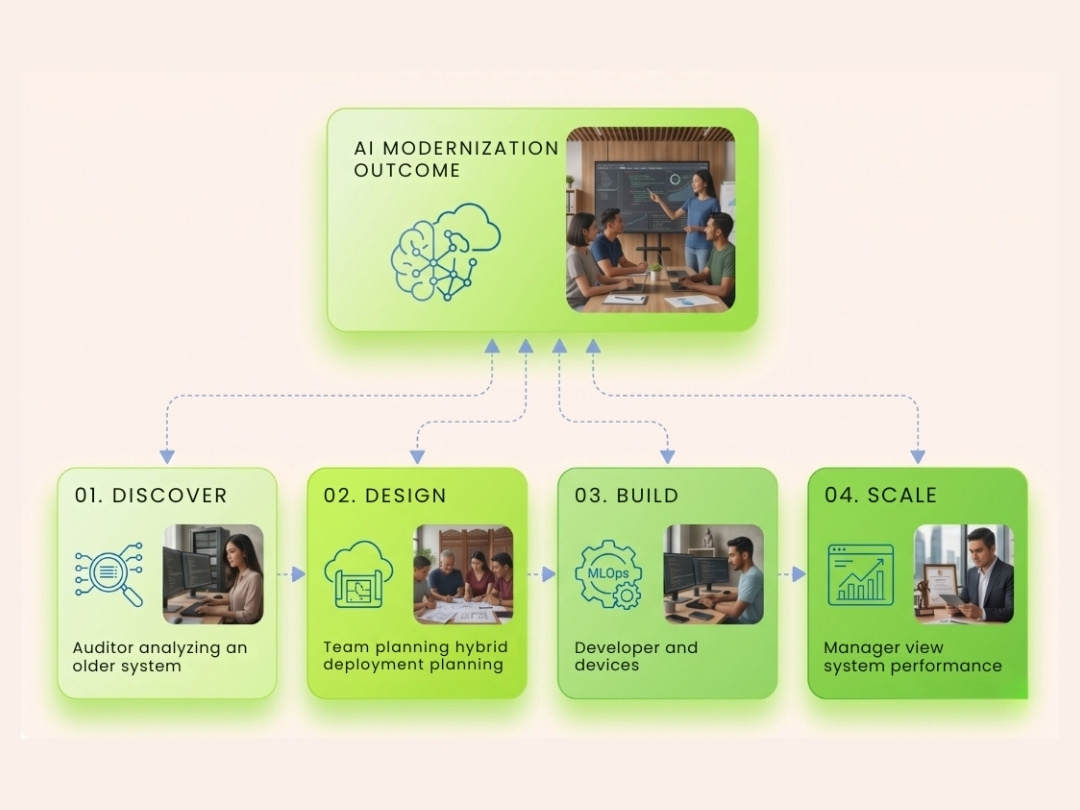
AI-Driven Application Modernization Workflow at Sprout
At Sprout, we ensure artificial intelligence integration goes beyond technical novelty to focus on system reliability and real business impact. We execute product engineering through 4 distinct phases:
01. Discover
We begin by auditing legacy system architectures, mapping data flows, and defining high-ROI business use cases. During this phase, monitoring instruments and data readiness baselines are established to confirm that existing problems strictly require AI solutions, rather than standard software automation.
02. Design
This phase architects the integration structure, choosing between Cloud, On-Premises, or Hybrid deployments, while designing Human-in-the-Loop interfaces. We establish efficient API contracts, data security boundaries, and transparent technical and operational success metrics.
03. Build
Senior software and AI engineers at Sprout construct MLOps pipelines, interface AI models with enterprise applications through microservices, and activate automated CI/CD pipelines from sprint one. Every system update is continuously tested for security and response accuracy.
04. Scale
Once the pilot program demonstrates strong usability and accuracy, focus shifts to full-scale production deployment. We manage release automation, model performance monitoring, infrastructure cost optimization, and ensure your team retains full ownership of codebases, monitoring dashboards, and system documentation.
Modernize Your Enterprise Applications with Sprout
Building modern enterprise applications powered by AI requires a software engineering partner experienced in managing complex system architectures, MLOps reliability, and business growth strategies.
As a digital product engineering and AI studio, Sprout helps your company design, build, and execute AI integrations that are secure, compliant, and market-ready.
Are you ready to move your AI initiatives from the experimental phase to production scale? Contact the Sprout specialist team today to discuss your project plans and receive a system readiness assessment.
FAQ (Frequently Asked Questions)
How long does it take to execute an AI pilot program through to full production?
A focused pilot program (PoC) typically takes 8 to 12 weeks to execute. Meanwhile, a full transition to production scale for enterprise applications generally takes 3 to 6 months, depending on legacy system complexity and data readiness.
How do we ensure sensitive company data remains protected when using AI models?
We enforce end-to-end encryption both at rest and in transit, isolated deployment environments via VPC or On-Premises, and strict Role-Based Access Control (RBAC). Complete ownership of data and AI models remains entirely with your enterprise.
When should a company choose AI over traditional software automation?
AI is ideal for scenarios requiring complex pattern recognition across unstructured data, such as documents, images, or natural language, as well as dynamic predictions. Conversely, routine processes with static, fixed business rules are far more efficient using traditional software automation.