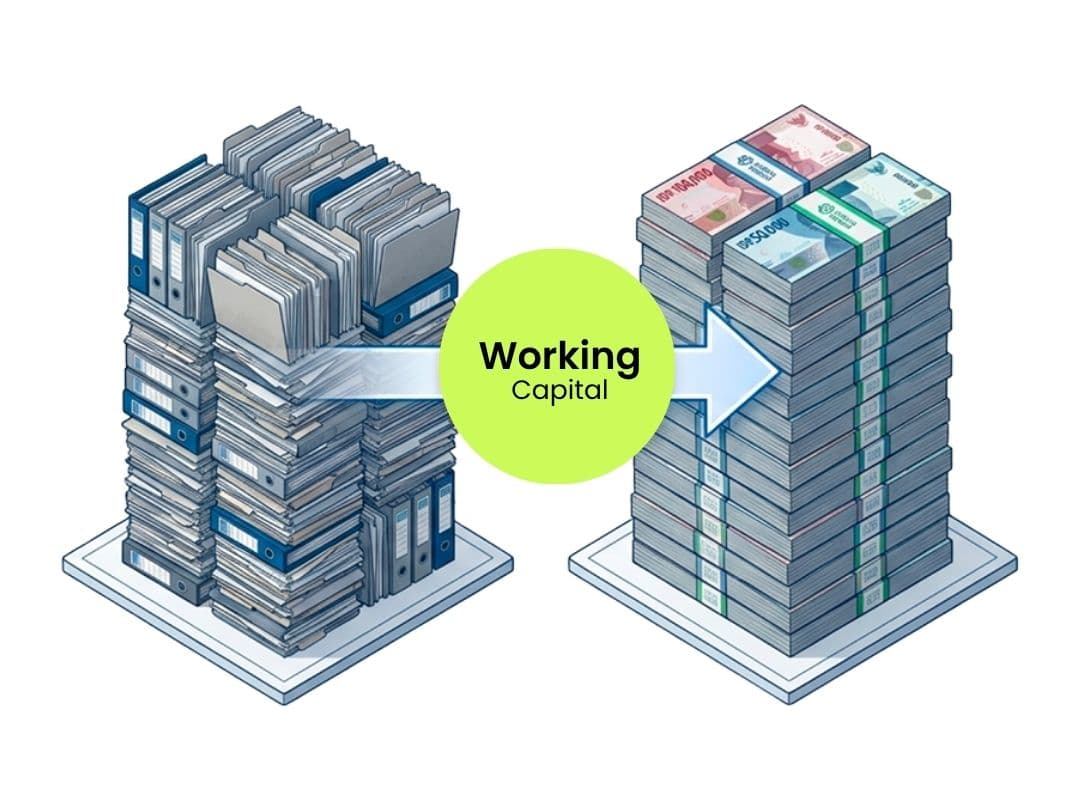

In an era of exceptionally massive information disruption, boards of directors and executive leaders now face major challenges in managing knowledge assets locked within piles of unstructured documents. Every day, corporations generate millions of data points in the form of invoices, contracts, technical reports, and customer correspondence that are often stored passively in digital repositories. The main problem faced is no longer about the lack of data availability, but rather the inability of organizations to extract strategic value from those information piles quickly and accurately. To overcome these structural barriers, world class companies are beginning to adopt advanced cognitive approaches to conduct autonomous data transformation. Through the application of precise cognitive technology, documents are no longer merely static piles of text, but dynamic entities providing tangible guidance for high level decision making. Understanding this information processing mechanism deeply is a highly crucial first step for business entities wishing to maintain their competitive advantage in an increasingly competitive and dynamic global market.
Beyond Traditional Data Extraction
As operational complexity increases, the reliance on manual processes to read and verify documents has become a major weakness for many large corporations. The limitations of human capacity in processing large scale information not only trigger bureaucratic delays, but also increase the risk of data misinterpretation which can be fatal for corporate financial stability. This is where the role of artificial intelligence becomes vital as a bridge connecting raw data with sharp business insights. By utilizing large scale language learning models, machines now possess the capacity to understand context, nuances, and important entities within documents with a level of accuracy surpassing conventional capabilities. This transformation allows companies to redirect their human resources from repetitive clerical tasks toward conceptual activities that are far more strategic, thus providing more significant added value for the long term growth of the organization as a whole.
Implementation of an Integrated Document Intelligence Strategy
The success of implementing this cognitive technology heavily depends on how the system is orchestrated into all business lines harmoniously. An Integrated Document Intelligence Strategy requires strong alignment between technological infrastructure and the overall corporate operational vision. This process begins with capturing data from various sources, both in physical and digital forms, and then transforming it into machine readable formats through advanced optical character recognition. However, the true strength of this architecture lies in the artificial intelligence layer capable of performing semantic analysis and automated classification of incoming information. With an integrated system, every document entering the corporate ecosystem will be automatically validated, categorized, and routed to the relevant departments without requiring any manual intervention. This creates an exceptionally smooth and efficient workflow, ensuring that crucial information is always available to decision makers at the right time.
Optimizing Accuracy Through Machine Learning
Behind the sophistication of data extraction lie natural language processing algorithms working hard to understand the intent and purpose of every written sentence. This technology enables the system to distinguish between contract clauses containing high risks and general information that is administrative in nature. This analytical capability is very important in supporting corporate risk management and compliance functions, especially where every small detail in legal documents can have major implications for the future of the company. With this contextual understanding capability, companies can conduct internal audits automatically and detect data anomalies much faster than using traditional, exhausting methods.
Advantages of an Integrated Document Intelligence Strategy
The real power of this smart information processing becomes clear when the system is synergized with broad and comprehensive workflow automation. Every piece of data successfully extracted from a document becomes an automatic trigger for the next operational action within the corporate system, thereby reducing execution lag time. For example, when an invoice is received and verified automatically, the system will immediately route the payment order to the finance division and update inventory records instantaneously. This synergy effectively eliminates information silos and ensures that every division works with consistent and real time updated data, which ultimately increases internal transparency significantly.
Reducing Operational Costs and Compliance Risks
To achieve sustainable business growth at an international level, companies require an infrastructure capable of handling exceptionally complex document formats and language diversity. This intelligent approach provides the capability for corporations to standardize operational processes across various global branch offices without having to lose unique local context. The system adaptability to various international regulations and different document formats makes this technology the primary driving motor for seamless and frictionless business expansion. By having a system capable of processing institutional knowledge automatically, companies can maintain consistency in service quality wherever they operate.
Navigating Global Scalability with Intelligent Systems
Ultimately, this entire series of technological innovations aims to provide clarity for executive ranks in designing bolder future strategic steps. When all document data has been transformed into structured insights, business leaders have an exceptionally strong database to conduct sharper and more accurate market predictions and competitor analysis. Decisions made based on real data extracted automatically will have a much higher accuracy level and more measurable risks, providing peace of mind for shareholders. Business resilience amidst global economic uncertainty heavily depends on how fast an organization can process information and turn it into profitable real action for the future of the company.
Realizing an intelligent corporate ecosystem free from administrative bottlenecks is a strategic investment that will define your company position in the coming decade. Optimizing the way an organization manages knowledge requires the steady hand of technology architects who understand the intricacies of digital product engineering and modern business dynamics deeply and comprehensively. Do not let the great potential of your company be locked in piles of poorly managed documents, so take tactical steps to modernize your information infrastructure right now. With the support of our specialist team focused on developing the most advanced cognitive solutions, your innovation aspirations will soon transform into an unmatched operational force in the industry. Immediately consult your cognitive transformation vision to ensure a business future that is far more efficient, intelligent, and sustainable for all stakeholders.